
Hunting the Invader: My Dive into Lionfish Culling

The first time I locked eyes with a lionfish underwater, I was struck by its beauty. Its fins billowed like delicate silk fans, striped in cream and burgundy, and for a moment I almost forgot why I was there. Spear in hand — heart pounding behind my rash guard. It was a gorgeous creature, but beauty can be deceptive, and this fish was no guest. It was an invader.
Lionfish aren’t supposed to be here. Native to the Indo-Pacific, they somehow slipped into the Atlantic and Caribbean, likely from home aquariums released decades ago. Since then, they’ve become the ocean’s silent conquerors. With no natural predators and a voracious appetite, they devour juvenile reef fish faster than ecosystems can recover. Entire schools disappear. Coral reefs lose their grazers, and algae smothers what’s left.
That’s why, one humid morning in Utila, I set off on my first lionfish culling expedition. The goal wasn’t glory — it was balance.
The boat ride out was a blur of motion and noise. Tanks clanking, people gathered around the freshwater bucket sloshing de-fog solution off their mask lenses, fins clapping against the deck as we scrambled to get ready. The air smelled of salt and boat exhaust. Excitement hummed between us like static. Everyone double-checked their gear and loudly boasted about how many lionfish they expected to spear. I could feel the collective anticipation alive in the air.
We leaped into the water, the trill of adrenaline running through our veins. Before we descended, the dive leader handed each of us a Hawaiian sling spear from a small containment tube that looked like a plastic quiver, called a zookeeper. The goal was clear: take only lionfish. Respect everything else. Kill swiftly and humanely.
Underwater, the chaos of the rocking boat faded away, and the world turned silent but alive with motion. The reef was a living city, damselfish darting between coral pillars, parrotfish crunching on algae, fairy basslets lounging in the shade of the reef. Then, a diver on my team spotted one — a lionfish tucked under a crevice, fanning its fins, completely unbothered by our presence. It didn’t even flinch as we neared.
My pulse quickened. I attempted to steady my shaking hands, exhaled slowly, and released the spear. The lionfish was far more nimble than I, and it darted further into the reef’s crevice. I never had the best aim when it came to sports, and the excitement of the expedition certainly didn’t helped. Luckily, other divers on my team had much better technique than I. My dive buddy leaped into action, pulling back her spear and firing into the crevice- a quick and decisive motion. As the fish twitched, she made the hand gesture of a gun. I understood this as the diving sign for “kill shot.” I handed her my spear; she took it and plunged it behind the tiny invader's eyes. Its red stripes flashed white, and then it stilled completely.
Trapped at the end of two spears, its lifeless body was carefully deposited into the zookeeper. After a moment of celebration, the adrenaline faded and we went back to scouting for more lionfish. As I looked around, I saw the abundance of small reef fish nearby, each one a reminder of what we were protecting.
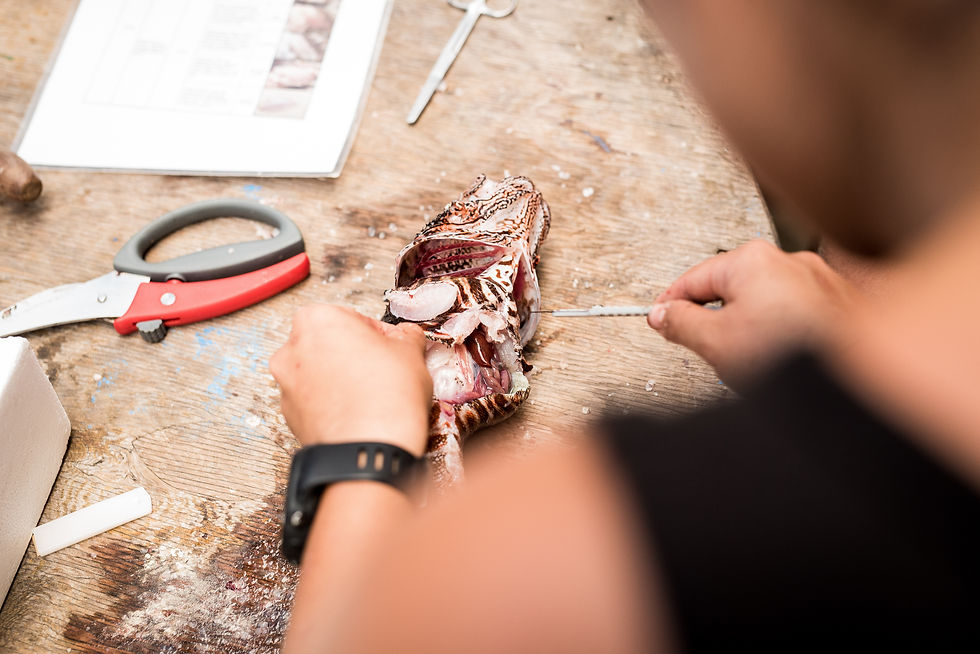
After the dive, the other WSORC interns and I gathered to weigh, measure, and sex the lionfish, recording data for conservation purposes. We cut off their beautiful, flowing fins and set them aside to be made into jewelry by a local artisan. A curious feline named Foxy came to help clean up the discarded fish scraps. Then, as the sun dipped low, we prepared the fish for dinner. The heads and bones were boiled down into a rich broth; the fillets were fried up and served with a delicate beurre blanc sauce. After sharing the meal, I couldn’t help but reflect on how almost no part of the lionfish went to waste. Every head, fin, and fillet served a purpose. As an eco-conscious marine conservation intern, that made the experience feel even more aligned with my values.
Taking a life, even for conservation, isn’t something I take lightly. But I’ve come to understand that protecting the reef sometimes means making difficult choices. Each lionfish removed gives native species a chance to thrive again. Each lionfish meal shared reminds us of the connection between humans and the ocean we depend on. Beyond the conservation impact, there was joy too. Laughing on the boat, cheering each successful catch, and swapping stories over dinner. The dives didn’t just protect the reef; they brought friends together through a shared sense of purpose. In the end, our culling dive wasn’t about destruction, it was about restoration, community, and the hope that one day, balance will return to the reef.


